- A Paradise for Parents Newsletter
- Posts
- Why We Should Link Morality to Health
Why We Should Link Morality to Health

Hal Cranmer
August 01, 2025
Don’t roll your eyes at me! I am not going to give you a lecture on being a better person in this email.
What I want to show you is how I think a sense of morality can help you improve your health. And why our lack of morality is hurting our overall health.
Recently I came across this article taking the opposite viewpoint. The title of the article is:
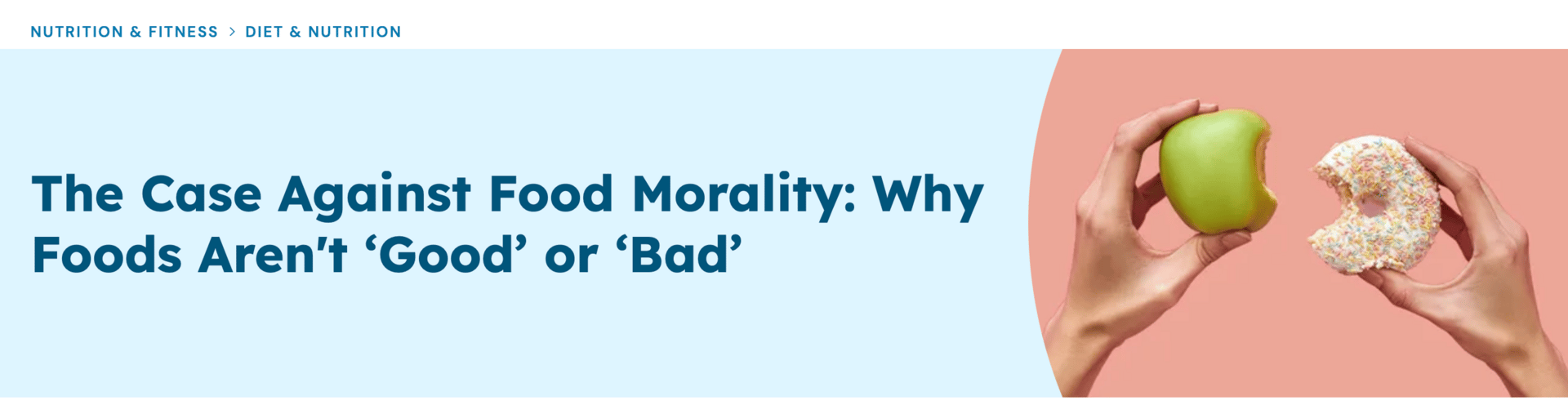
The article talks about how some foods are considered ‘good’ (fruits, vegetables and unprocessed food - no mention of meat of course) and some are considered ‘bad’ (desserts).
According to experts that is a very unhealthy way to think about healthy eating. You shouldn’t think of foods as ‘good or bad’:
“Healthy eating depends on your own unique needs,” Lampert says, giving the example of a mango as a food that’s great for most people, but life-threatening to those who are allergic.
Similarly, sugary drinks aren’t the most nutritious choice most of the time, but can be extremely helpful to keep energy up during an endurance sports event, or as a way for someone with diabetes to reverse low blood sugar quickly.
And salads are filled with nutrient-dense veggies and other foods, but eating only salad for every meal could lead to deficiencies in other nutrients (like fat and protein) and could be a sign of disordered eating.
Because of all these little complexities, there’s no one way to eat healthy. And, while different foods have different nutrition contents, no single food is inherently good or bad.”
The article then goes on to say that injecting morality into food choices increases “fat phobia” or an inherent bias against fat people.
Let me deal with the second point first. Everyone has their own morality. Whether it comes from religion, the law, or just your own moral compass. We all have a sense of right or wrong.
My morality says not to make fun of other people. I left fat jokes behind in elementary school (well, maybe high school). But my morality also tells me that God wants me to treat my body like a temple.
To me that sounds like I should always strive to avoid being fat. Probably easier for me to do than other people. I’ve never really had a problem with it. I understand that it’s hard for others.
That doesn’t mean they shouldn’t try.
Morality to me means aspiring to adhere to a strong code.
Don’t lie.
Don’t cheat.
Don’t steal.
Lots of other requirements. These aren’t rules you say once and then assume you will never have any problems with them. The very nature of morality is that you work every darn day to stick to them.
Temptations arise.
‘Nobody will notice.’
“It’s just a little sin.’
Every day we fight those temptations.
Starting to see the parallels with eating? I think there are some foods that are inherently good and inherently bad. And my foods may be different from your foods. That’s fine. Eat what works for you.
However, I think we all have a sense that there are some good and bad foods for us. Think of your diet from a moral perspective. When you’re tempted by a bad food, react to that feeling like your reaction to the temptation to lie, cheat or steal.
Fight it. Tell yourself it’s wrong. Remember how it was when you resisted other temptations. Tough in the moment. Much better in the long run.
If you do succumb to temptation, confess your sin and resolve not to do it again. Don’t just rationalize it away.
I’ve found linking bad food to a bad moral decision has helped me cut a lot of junk from my diet. I hope it can help you as well.